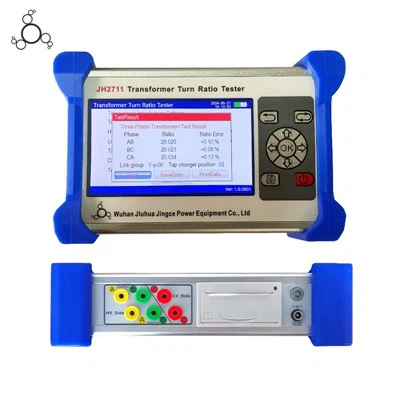
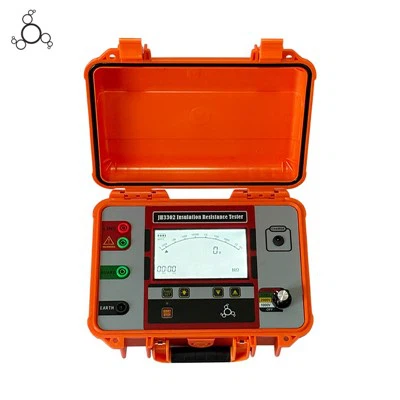
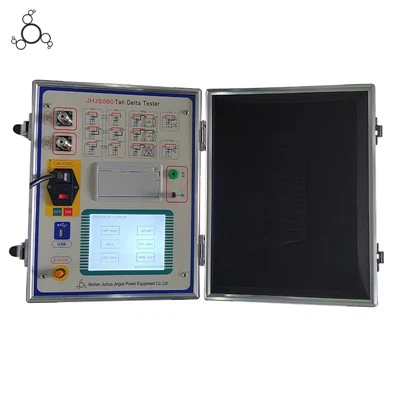
High Voltage Hipot Tester for Industrial Electrical Equipment and Transformer Insulation Quality Verification
A high voltage tester (hipot tester) applies a controlled over-voltage across electrical insulation barriers to verify dielectric strength and detect insulation defects, micro-voids, or inadequate creepage distances before equipment deployment. Designed for production floor testing and electrical laboratory environments, these units deliver stable AC and DC test voltages up to 100 kV with real-time leakage current monitoring. Procurement teams and quality managers select these instruments to ensure compliance with international electrical safety standards, prevent field insulation failure, and verify manufacturing consistency for transformers, switchgear, and industrial motors.
-
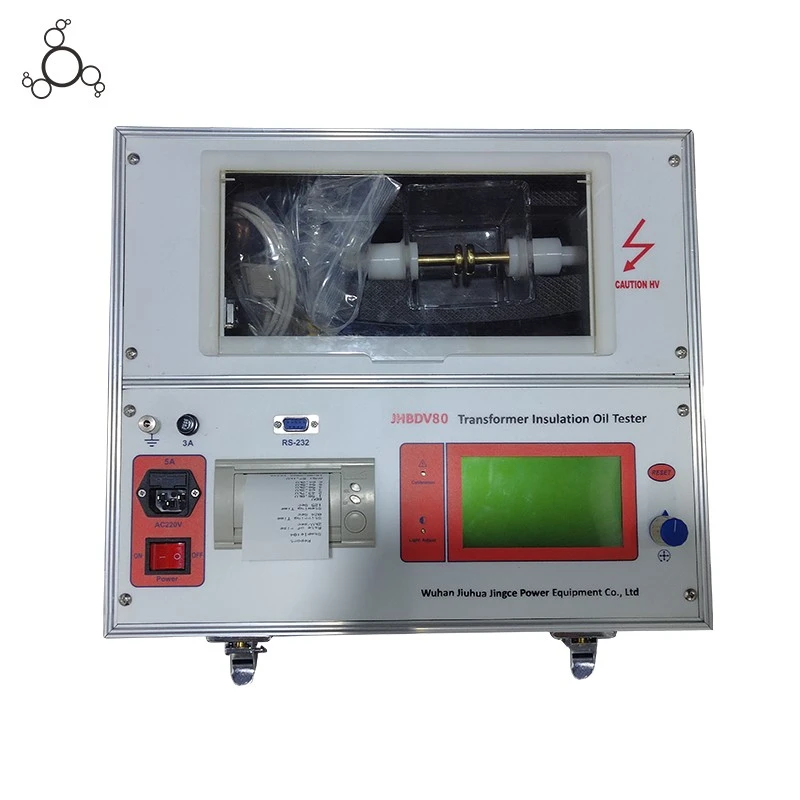
![80kV Insulating Oil BDV Tester]() 80kV Insulating Oil BDV TesterJHBDV80 is a professional Insulating Oil Breakdown Voltage Tester independently developed for power system transformer oil detection, supporting breakdown voltage test on power transformer oil and
80kV Insulating Oil BDV TesterJHBDV80 is a professional Insulating Oil Breakdown Voltage Tester independently developed for power system transformer oil detection, supporting breakdown voltage test on power transformer oil and -
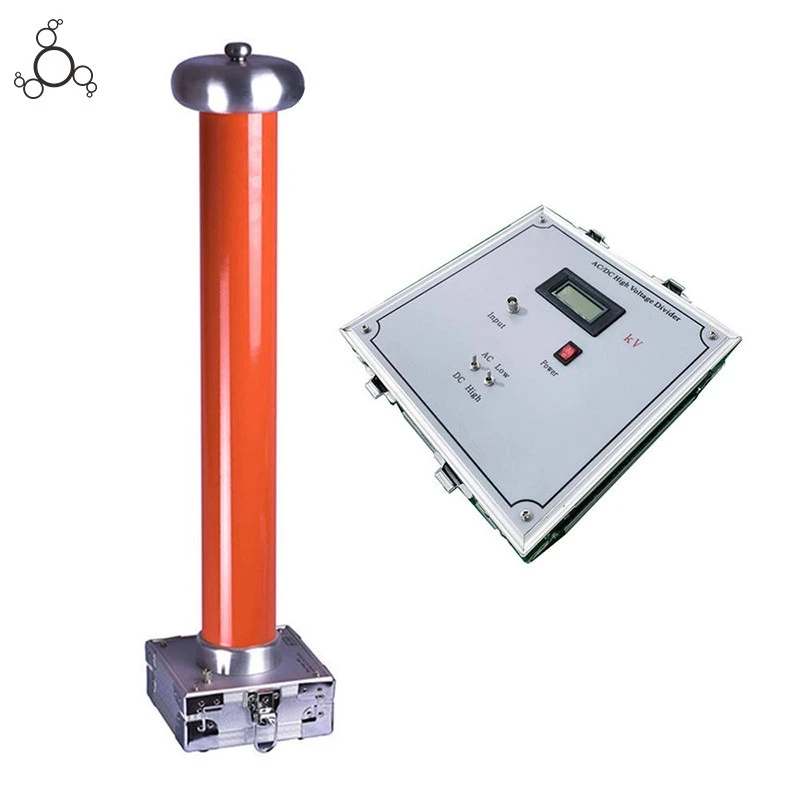
![150kV 200kV AC DC High Voltage Divider]() 150kV 200kV AC DC High Voltage DividerThis product is an ideal hv divider for HV measuring; mostly applied in power systems and electronic equipment factories to test power frequency AC high voltage and DC high voltage. As a professional
150kV 200kV AC DC High Voltage DividerThis product is an ideal hv divider for HV measuring; mostly applied in power systems and electronic equipment factories to test power frequency AC high voltage and DC high voltage. As a professional -
![Automatic Oil Moisture Tester with Graph Curve Analysis]() Automatic Oil Moisture Tester with Graph Curve Analysis1.The 32-bit embedded microprocessor is used as the main control core to embed the mini operating system.. 2.0-400ma automatic detection, high precision, fast measurement speed, stable and reliable..
Automatic Oil Moisture Tester with Graph Curve Analysis1.The 32-bit embedded microprocessor is used as the main control core to embed the mini operating system.. 2.0-400ma automatic detection, high precision, fast measurement speed, stable and reliable.. -
![100kV 5kVA AC DC Hipot Tester]() 100kV 5kVA AC DC Hipot TesterThis product (hereinafter referred to as YDJ type power frequency AC withstand voltage test complete set device) is a new type of product produced based on the TDM (G) series lightweight AC/DC
100kV 5kVA AC DC Hipot TesterThis product (hereinafter referred to as YDJ type power frequency AC withstand voltage test complete set device) is a new type of product produced based on the TDM (G) series lightweight AC/DC -
![Partical Discharge Meter]() Partical Discharge MeterThis manual provides information on how to use this product in a safe manner. Before you use the product for the first time, please read the instructions carefully to help you use the product
Partical Discharge MeterThis manual provides information on how to use this product in a safe manner. Before you use the product for the first time, please read the instructions carefully to help you use the product -
![30kV 40kV 50kV 60kV 80kV VLF Tester]() 30kV 40kV 50kV 60kV 80kV VLF TesterHigh voltage withstand test of electrical equipment is one of the most important items specified in insulation preventive test.The withstand voltage test can be divided into ac withstand voltage test
30kV 40kV 50kV 60kV 80kV VLF TesterHigh voltage withstand test of electrical equipment is one of the most important items specified in insulation preventive test.The withstand voltage test can be divided into ac withstand voltage test -
![VLF with Tan Delta and PD]() VLF with Tan Delta and PDThe VLF Tan Delta PD tester adopts digital frequency conversion technology, microcontroller control, and is fully automated for boosting, reducing voltage, measuring, and protecting. Due to its fully
VLF with Tan Delta and PDThe VLF Tan Delta PD tester adopts digital frequency conversion technology, microcontroller control, and is fully automated for boosting, reducing voltage, measuring, and protecting. Due to its fully -
![60kV 2mA 3mA 5mA 10mA Integrated DC Hipot Tester]() 60kV 2mA 3mA 5mA 10mA Integrated DC Hipot TesterThe instrument adopts high frequency voltage doubling circuit, using the latest PWM pulse width modulation technology and the voltage and current double closed loop feedback technology to improve the
60kV 2mA 3mA 5mA 10mA Integrated DC Hipot TesterThe instrument adopts high frequency voltage doubling circuit, using the latest PWM pulse width modulation technology and the voltage and current double closed loop feedback technology to improve the -
![120KV 2mA 3mA 5mA 10mA Integrated Generator DC Hipot Tester]() 120KV 2mA 3mA 5mA 10mA Integrated Generator DC Hipot TesterThe ZGS series integrated DC high-voltage generator is a high-performance electrical test instrument independently developed for high-voltage insulation withstand voltage tests of electrical
120KV 2mA 3mA 5mA 10mA Integrated Generator DC Hipot TesterThe ZGS series integrated DC high-voltage generator is a high-performance electrical test instrument independently developed for high-voltage insulation withstand voltage tests of electrical -
![200kV 2mA 3mA 5mA 10mA DC High Voltage Generator]() 200kV 2mA 3mA 5mA 10mA DC High Voltage GeneratorThe ZGS Series 200kv/3mA DC High Voltage Generator is a split-type high-voltage testing device designed for on-site and laboratory testing of medium and high-voltage electrical equipment. It
200kV 2mA 3mA 5mA 10mA DC High Voltage GeneratorThe ZGS Series 200kv/3mA DC High Voltage Generator is a split-type high-voltage testing device designed for on-site and laboratory testing of medium and high-voltage electrical equipment. It -
![50kV 3kVa Oil Immersed AC DC Hipot Tester]() 50kV 3kVa Oil Immersed AC DC Hipot TesterEspecially suitable for conducting insulation strength tests on various high-voltage electrical equipment, electrical components, and insulation materials under power frequency or DC high voltage in
50kV 3kVa Oil Immersed AC DC Hipot TesterEspecially suitable for conducting insulation strength tests on various high-voltage electrical equipment, electrical components, and insulation materials under power frequency or DC high voltage in -
![50kV 5kVA AC and DC Hipot Tester]() 50kV 5kVA AC and DC Hipot TesterThe 50kV 5kVA AC And DC Hipot Tester is a high-performance core device of TDM(G) series AC/DC power frequency withstand voltage test equipment, manufactured in strict compliance with national
50kV 5kVA AC and DC Hipot TesterThe 50kV 5kVA AC And DC Hipot Tester is a high-performance core device of TDM(G) series AC/DC power frequency withstand voltage test equipment, manufactured in strict compliance with national


Testing Capabilities & Product Types
AC High Voltage Testers: Delivers sinusoidal AC test voltages up to 50 kV AC for evaluating dielectric strength under alternating electrical stress, identifying insulation breakdown and excessive leakage current.
DC High Voltage Testers: Provides filtered DC output up to 100 kV for testing capacitive loads, power cables, and high-voltage DC transmission components without excessive charging current interference.
AC/DC Combined Hipot Systems: Dual-mode testing platforms equipped with software-selectable AC and DC outputs to accommodate diverse product safety standards within a single test station.
Automated Multi-Channel Testing Cabinets: Integrated multi-point scanning systems configured for concurrent or sequential testing of multi-winding transformers and complex electrical harness assemblies.
Technical Specifications
| Output Voltage Range | Current Measurement Range | Voltage Regulation | Trip Current Resolution | Interfaces & Communication |
| 0 to 50 kV AC | 0 to 20 mA | <= +/-1% of full scale | 0.1 mA | RS485, PLC I/O, USB |
| 0 to 100 kV DC | 0 to 10 mA | <= +/-1% of full scale | 0.01 mA | Modbus RTU, Ethernet, PLC |
| 0 to 50 kV AC / 0 to 60 kV DC | AC: 0 to 50mA / DC: 0 to 20mA | <= +/-0.5% of full scale | 0.01 mA / 0.1 mA | RS232, PLC 24V I/O, USB |
| 0 to 80 kV AC (Multi-channel) | 0 to 100 mA | <= +/-0.5% of full scale | 0.01 mA | Profinet, Ethernet/IP, PLC |
| Parameter | Specification |
| Input Power | AC 220V/380V +/-10%, 50/60 Hz |
| Power Configuration | Single-phase or three-phase, depending on model configuration |
| Duty Cycle | Continuous operation for automated production lines |
| Ramp Time | Programmable from 0.1 to 99.9 seconds |
| Discharge Circuit | Automatic active internal discharge network upon test completion or interlock trip |
Zero-Crossing Voltage Initiation: Circuitry switches output voltage exclusively at AC waveform zero-crossing points to eliminate transient voltage spikes and protect sensitive test articles from impulse stress.
Real-Time Arc Detection: High-speed current sampling circuits detect micro-arcs and sudden insulation flashover events within 2 milliseconds, immediately cutting output power.
Hardware Interlock Protection: External safety interlock terminals connect directly to enclosure safety cages or test fixture door switches to prevent high-voltage generation when access panels are open.
Isolated Measurement Circuitry: Low-voltage control circuits are optically isolated from high-voltage generation stages to protect operator interface terminals and external data loggers.
Data Storage & Traceability: Internal memory logs up to 10,000 test results with timestamp, applied voltage, leakage current, and pass/fail status for quality audit trails.
Test Applications
Power Transformers
Verifies turn-to-turn and winding-to-core insulation integrity on distribution and power transformers prior to oil filling and tank sealing.
Switchgear & Distribution Cabinets
Evaluates busbar clearance, creepage distances, and solid insulation barriers in medium-voltage switchgear assemblies.
Electric Vehicle Powertrains
Tests stator windings, high-voltage wiring harnesses, and battery pack isolation barriers against high-potential breakdown.
Industrial Motors & Generators
Assesses stator and rotor insulation health following rewinding or high-volume assembly line production.

How to Choose the Right Tester
Determine Test Voltage Requirements
Calculate the required test voltage based on the operating voltage of the device under test (DUT). Standard industrial practice typically requires test voltages equal to twice the working voltage plus 1,000 volts, or as specified by applicable IEC/UL standards.
01
Select AC vs. DC Output
Choose AC testing for standard production line verification where capacitive charging current is manageable. Select DC testing for high-capacitance loads including long cables and large generators to avoid thermal overload from high capacitive charging currents.
02
Evaluate Current Resolution & Trip Limits
Ensure the tester maximum current output and trip sensitivity match the leakage current profile of your product without triggering false failures from normal capacitive leakage.
03
Integration Level
Select standalone benchtop units for manual station testing or PLC-compatible units with industrial bus communication such as Profinet and Modbus for automated conveyor integration.
04
Manufacturing & Quality Control
Transformer Winding In-House
High-frequency and power transformers utilized within our test units are wound on automated CNC winding machines with tension-controlled copper wire to ensure magnetic coupling stability.
PCB Assembly
Surface-mount circuit boards undergo automated optical inspection and in-circuit testing prior to conformal coating for moisture and dust resistance.
Dielectric Breakdown Staging
High-voltage output transformers and multiplier circuits are vacuum-impregnated with high-grade epoxy resin to eliminate internal corona discharge and partial discharge vulnerabilities.
Calibration Verification
Every finished instrument is calibrated using NIST-traceable high-voltage dividers and digital electrometers, with individual calibration certificates generated prior to dispatch.
Custom Enclosure Integration: 19-inch rack-mount configurations or custom floor-standing console integration tailored to existing automated test bench layouts.
Software Protocol Adaptation: Proprietary communication protocols and custom GUI software development for seamless integration into factory Manufacturing Execution Systems.
Specialized Test Fixtures: Design and fabrication of custom high-voltage test probes, safety enclosures, and pneumatic clamping test fixtures for specific component geometries.
OEM Branding: Private labeling, custom front-panel layouts, and documentation localization for instrument distributors and equipment manufacturers.
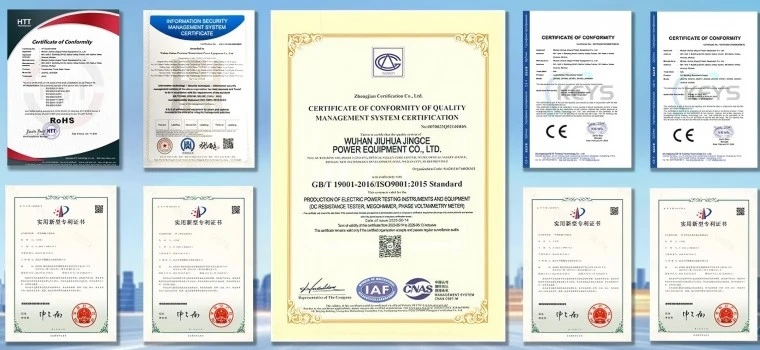
Documentation & Certifications
Compliance Standards
Manufactured in accordance with IEC 61010-1 for safety requirements of electrical equipment for measurement, control, and laboratory use, alongside IEC 60364 standards.
Certifications
CE marked, RoHS compliant, and available with ISO/IEC 17025 accredited calibration certificates upon request.
Shipped Documentation
Each unit includes a printed English user manual, wiring schematics, calibration certificate, maintenance guide, and digital software toolkit on USB drive.
Certifications
FAQ
Q: What is the difference between AC and DC high voltage testing?
A: AC testing stresses the insulation in both polarity directions, closely simulating real-world operational stress, and detects both resistive and capacitive leakage currents. DC testing applies unidirectional voltage, eliminating capacitive current interference, which makes it suitable for high-capacitance items like long power cables, though it requires controlled discharge procedures after testing.
Q: How does the tester protect the operator from electric shock?
A: The equipment incorporates a multi-layer safety architecture, including a hardware safety interlock loop connected to external test enclosures, automatic active discharge circuitry that drains stored capacitive energy within seconds of test completion, and zero-start voltage interlocks that prevent test initiation unless the voltage regulator is at zero.
Q: What causes a false fail during high-voltage testing?
A: False failures typically occur when capacitive leakage current from long cables, large transformers, or damp test environments exceeds the set trip threshold. Adjusting the trip current limit or switching from AC to DC testing for high-capacitance loads resolves this condition.
Q: Can these testers be integrated into fully automated PLC production lines?
A: Yes. All standard models feature isolated 24V DC digital I/O ports and industrial communication interfaces including Modbus RTU, RS485, and Ethernet enabling PLC start, stop, pass, and fail signal handshake integration with automated conveyor test stations.
Q: How often should the high voltage tester be recalibrated?
A: We recommend annual recalibration using NIST-traceable high-voltage measurement standards to maintain measurement accuracy and satisfy ISO 9001 quality management system audit requirements.
Q: What is the standard lead time for standard versus customized units?
A: Standard catalog models ship within 7 to 10 business days. Custom voltage configurations, specialized multi-channel enclosures, or tailored MES software integrations typically require 3 to 5 weeks depending on engineering requirements.
Q: What warranty terms and technical support are provided?
A: All units include a 2-year standard manufacturer warranty covering parts and workmanship, supported by remote engineering diagnostics, firmware updates, and replacement part availability.
As one of the most experienced high voltage tester manufacturers in China, we offer a wide range of products with superior quality. Please feel free to wholesale bulk durable high voltage tester from our factory. For price consultation, contact us.