Transformer Tester for Power Transformer Testing and Maintenance
Power transformers represent critical capital assets within transmission and distribution networks. Routine diagnostic evaluation and factory acceptance testing (FAT) verify electrical integrity, detect hidden turn-to-turn insulation degradation, and prevent catastrophic grid failures. This product category encompasses portable and stationary testing instruments engineered to measure winding resistance, turns ratio, insulation resistance, short-circuit impedance, and dielectric dissipation factor (tan delta) across oil-immersed, dry-type, and special-purpose transformers.
-
![DC Winding Resistance Tester]() DC Winding Resistance TesterThis transformer DC winding resistance tester is specially designed for dc winding resistance test, solving the pain point of time-consuming and labor-intensive traditional testing. Equipped with new
DC Winding Resistance TesterThis transformer DC winding resistance tester is specially designed for dc winding resistance test, solving the pain point of time-consuming and labor-intensive traditional testing. Equipped with new -
![Three Phase Transformer Turns Ratio Tester]() Three Phase Transformer Turns Ratio Tester1. The three-phase CNC sine inverter power supply output has soft start and soft stop functions, so the testing speed is fast and the accuracy is high,which is suitable for ttr electrical testing in
Three Phase Transformer Turns Ratio Tester1. The three-phase CNC sine inverter power supply output has soft start and soft stop functions, so the testing speed is fast and the accuracy is high,which is suitable for ttr electrical testing in -
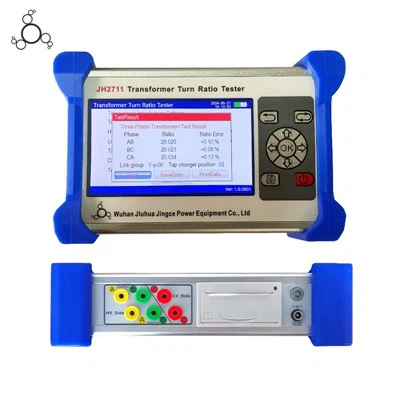
![Handheld Three Phase Transformer Turns Ratio Tester]() Handheld Three Phase Transformer Turns Ratio Tester1. The three-phase CNC sine inverter power supply output has soft start and soft stop functions, so the testing speed is fast and the accuracy is high.. 2. Three phase transformer, single-phase
Handheld Three Phase Transformer Turns Ratio Tester1. The three-phase CNC sine inverter power supply output has soft start and soft stop functions, so the testing speed is fast and the accuracy is high.. 2. Three phase transformer, single-phase -
![Transformer Turns Ratio and Winding Resistance Tester]() Transformer Turns Ratio and Winding Resistance Tester1.One time wiring, capable of completing DC resistance testing and transformer turns ratio tester.. 2.Direct resistance testing function, for Yn type, Y type, and △ type windings, three-phase
Transformer Turns Ratio and Winding Resistance Tester1.One time wiring, capable of completing DC resistance testing and transformer turns ratio tester.. 2.Direct resistance testing function, for Yn type, Y type, and △ type windings, three-phase -
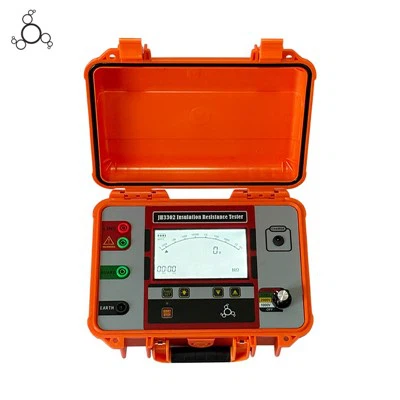
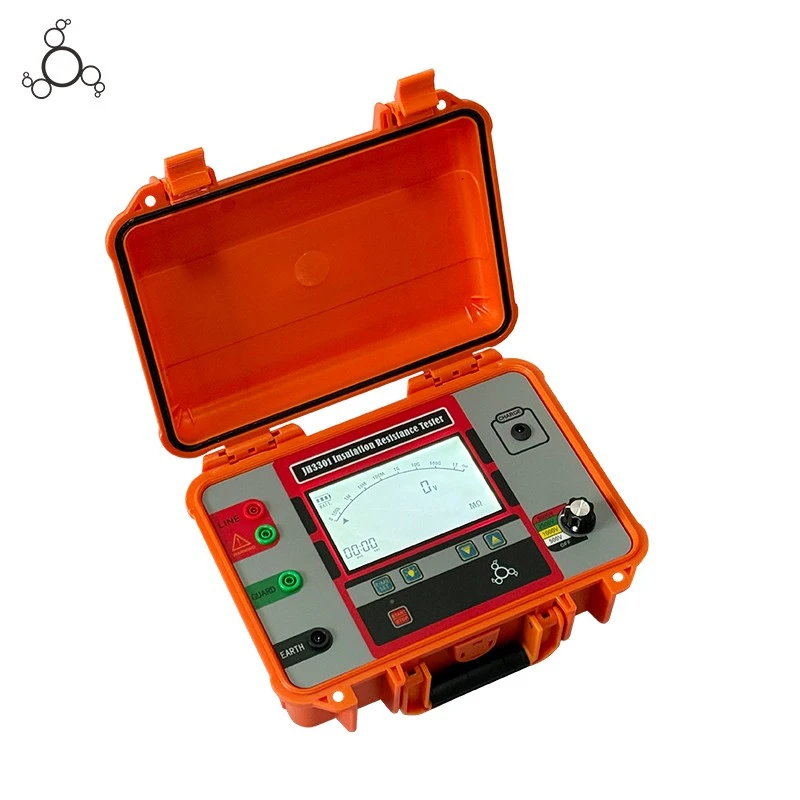
![10kV Wide Range Insulation Resistance Tester]() 10kV Wide Range Insulation Resistance TesterThe digital insulation resistance tester only uses a 5-inch large screen display, uses high-precision ADC to measure the measured insulation resistance, and integrates timing testing, absorption
10kV Wide Range Insulation Resistance TesterThe digital insulation resistance tester only uses a 5-inch large screen display, uses high-precision ADC to measure the measured insulation resistance, and integrates timing testing, absorption -
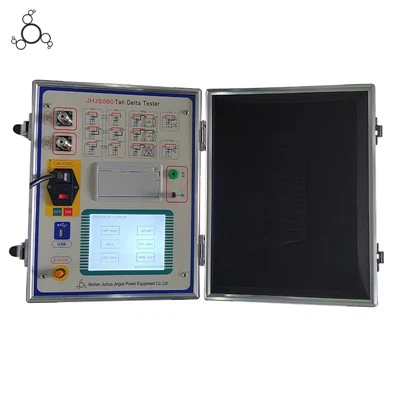
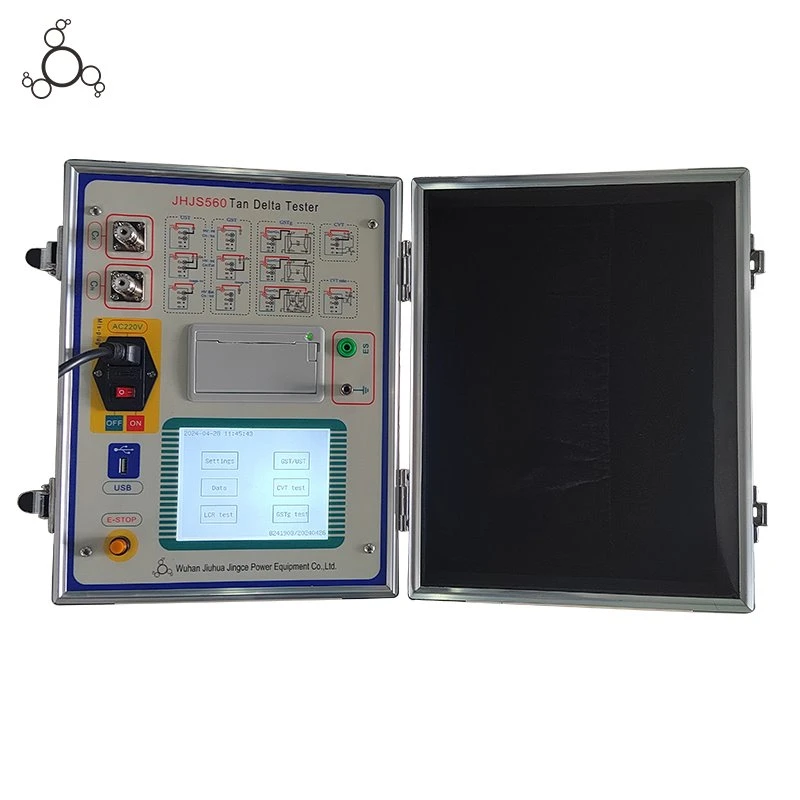
![Tan Delta Tester Transformer]() Tan Delta Tester TransformerJHJS560 Different Frequency Automatic Dielectric is a high-precision instrument, which can be applied to automatically measure electrical loss tangent (Tgδ) and capacitance of all kinds of high
Tan Delta Tester TransformerJHJS560 Different Frequency Automatic Dielectric is a high-precision instrument, which can be applied to automatically measure electrical loss tangent (Tgδ) and capacitance of all kinds of high -
![Transformer DC Winding Resistance Tester]() Transformer DC Winding Resistance Tester1.The winding resistance tester provides 7-gear output current selection and an automatic gear, with a maximum output of 10A current. 2.It is applicable to inductive test objects such as transformer,
Transformer DC Winding Resistance Tester1.The winding resistance tester provides 7-gear output current selection and an automatic gear, with a maximum output of 10A current. 2.It is applicable to inductive test objects such as transformer, -
![Handheld Transformer DC Resistance Tester]() Handheld Transformer DC Resistance TesterTrue Handheld Design: Weighs only 1.6kg for easy one-handed operation.10A Max Output: Covers 500μΩ to 50KΩ testing range.Auto-Current Selection: Automatically picks the best test
Handheld Transformer DC Resistance TesterTrue Handheld Design: Weighs only 1.6kg for easy one-handed operation.10A Max Output: Covers 500μΩ to 50KΩ testing range.Auto-Current Selection: Automatically picks the best test -
![Winding Resistance Tester Three Phase Unbalance Test]() Winding Resistance Tester Three Phase Unbalance Test⚡ Test 3 Phases at Once⏱️ Cuts Testing Time by 66%🛡️ Safe Auto-Discharge Alarm📊 Auto Unbalance Calculation🔋 High 20A Fast Output💾 Stores 500+ Test Records🌡️ Built-in Temp Compensation🏗️ Rugged
Winding Resistance Tester Three Phase Unbalance Test⚡ Test 3 Phases at Once⏱️ Cuts Testing Time by 66%🛡️ Safe Auto-Discharge Alarm📊 Auto Unbalance Calculation🔋 High 20A Fast Output💾 Stores 500+ Test Records🌡️ Built-in Temp Compensation🏗️ Rugged -
![10A DC Winding Resistance Tester]() 10A DC Winding Resistance Tester1.The instrument provides 6-gear output current selection and an automatic gear. The maximum output current is 10A, which is specially designed for accurate dc winding resistance measurement of
10A DC Winding Resistance Tester1.The instrument provides 6-gear output current selection and an automatic gear. The maximum output current is 10A, which is specially designed for accurate dc winding resistance measurement of -
![DC Winding Resistance Tester 20A]() DC Winding Resistance Tester 20AThis winding resistance tester adopts a new power supply technology, which has the characteristics of small size, light weight, high output current, good repeatability, strong anti-interference
DC Winding Resistance Tester 20AThis winding resistance tester adopts a new power supply technology, which has the characteristics of small size, light weight, high output current, good repeatability, strong anti-interference -
![Transformer Turns Ratio Tester with Neutral Point]() Transformer Turns Ratio Tester with Neutral Point1.Dedicated Neutral Point: Test Yn/yn and Z-type transformers without auxiliary wiring2.All-in-One Testing: 3-phase, single-phase, Z-type, PT, CT with auto vector group ID3.0.9–20,000 Ratio Range:
Transformer Turns Ratio Tester with Neutral Point1.Dedicated Neutral Point: Test Yn/yn and Z-type transformers without auxiliary wiring2.All-in-One Testing: 3-phase, single-phase, Z-type, PT, CT with auto vector group ID3.0.9–20,000 Ratio Range:


Transformer DC Winding Resistance Testers: Delivers regulated test currents up to 20A across 6 to 7 output gears to identify loose internal connections, broken strands, or tap changer contact resistance anomalies in inductive loads.
Transformer Turns Ratio (TTR) Testers: Utilizes three-phase CNC sine inverter power supplies with soft-start/stop functions to measure voltage transformation ratios, vector group identification, and phase angle deviation across single-phase, three-phase, Z-type, PT, and CT units.
Insulation Resistance (IR) / Megohmmeter Testers: Applies selectable test voltages up to 10kV with integrated polarization index (PI) and dielectric absorption ratio (DAR) automated calculation algorithms to evaluate solid insulation condition.
Tan Delta / Dielectric Loss Testers: Employs variable-frequency automatic resonance technology to measure capacitance and dissipation factor (tan delta) under high-voltage test conditions, detecting moisture ingress and aging in oil-paper insulation systems.
Short-Circuit Impedance & Load Loss Testers: Evaluates winding deformation, shifting, or mechanical displacement resulting from through-fault currents without requiring transformer dismantling.
Technical Specifications
| Parameter | Specification |
| Winding Resistance Measurement Range | 0.1 micro-ohm to 100 ohms |
| Winding Resistance Accuracy | +/- (0.2% + 2 micro-ohms) |
| Test Current Output | 1A, 3A, 5A, 10A, 20A DC |
| Protection Functions | Automatic discharge circuits and magnetic saturation protection |
| Turns Ratio Measurement Range | 0.9 to 10,000 |
| Turns Ratio Accuracy | +/- 0.1% (0.9 to 500); +/- 0.2% (500 to 2,000) |
| Tan Delta Measurement Range | 0.00001 to 10.0 |
| Tan Delta Accuracy | +/- (1% + 0.0001) |
| Operating Power Supply | AC 220V +/- 10%, 50/60Hz; internal rechargeable lithium-ion battery pack for field operation |
| Enclosure Rating | IP65 |
| Enclosure Design | Ruggedized industrial field casing with impact-resistant polymer molding and sealed interface panels |
Key Features
One-Time Wiring Configuration: Integrated combination units execute both DC resistance and turns ratio sequences via a single connection hookup, reducing testing time per unit by over 40%.
Strong Electromagnetic Interference (EMI) Suppression: Built-in digital filtering and isolated grounding architecture allow stable operation inside active 500kV substations.
Automatic Vector Group Recognition: TTR firmware instantly calculates vector displacement angles (0 degrees to 360 degrees) without manual phase identification charts.
Data Storage and Retrieval: Internal flash memory records up to 1,000 test reports, exportable via USB interface or thermal micro-printer.
Safety Discharge Interlocks: Automatic acoustic-optic discharging circuits prevent residual inductive energy hazards upon test completion.
Test Applications
Transformer Manufacturing Facilities: Routine and type testing on medium-to-large power transformers during final assembly quality gates.
Electric Utility Substation Maintenance: Periodic preventive diagnostic testing on transmission grid step-up and step-down transformers.
Independent Testing Organizations (NETA/ISO 17025): Commissioning audits, pre-energization verification, and post-fault diagnostic assessments.
Railway Electrification Grids: Traction transformer diagnostic checks on locomotive-mounted and wayside substation units.

How to Choose the Right Tester
Determine Voltage and Capacity Ratings
Distribution transformers (under 35kV) require standard 10A resistance and 10kV insulation meters; transmission transformers (over 110kV) require automated multi-parameter test systems with high-voltage tan delta capabilities.
Evaluate Testing Environment
Field technicians performing mobile maintenance should prioritize lightweight, battery-powered handheld units with IP65 ingress protection. Factory test benches benefit from multi-channel automated rack-mounted systems.
Verify Compliance Standards
Ensure the instrument meets local grid testing protocols, specifically IEC 60076 or IEEE C57 test methodologies, for legally admissible utility acceptance reports.
Manufacturing & Quality Control
Core Component Sourcing
Precision resistors and ADCs utilize military-grade temperature-compensated components to prevent drift under extreme ambient thermal conditions (-20 degrees C to +50 degrees C).
Automated Calibration Benches
Every instrument passes through automated multi-point voltage and current calibration loops benchmarked against Fluke electrical standards.
Burn-In Stress Testing
Finished electronic boards undergo 48-hour continuous thermal stress aging at +55 degrees C inside programmable environmental chambers to eliminate infant mortality failures.
Software Localization: Multilingual user interface firmware available in English, Spanish, French, Russian, and custom regional utility dialects.
Hardware Modification: Tailored test lead lengths, specialized Kelvin clip adapters, and customized enclosure branding for regional distribution partners.
OEM/ODM Partnership: Custom enclosure design and specialized measurement protocol integration tailored to enterprise catalog requirements.
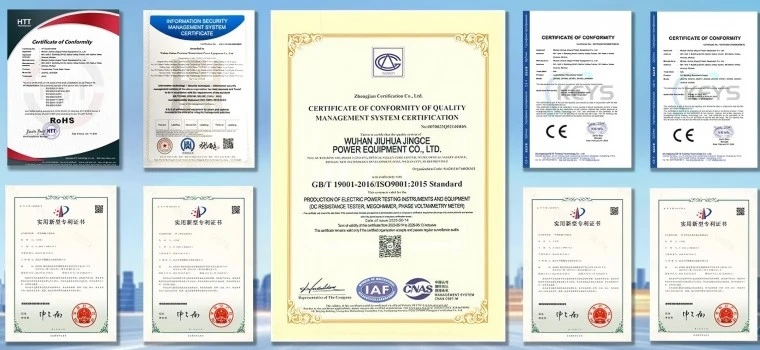
Documentation & Certifications
Compliance Certificates
CE electrical safety and EMC directive certification, ISO 9001 quality management system manufacturing compliance.
Calibration Reports
Each unit ships with an individual factory calibration certificate carrying traceable serial numbers.
Technical Deliverables
Hardcopy and digital user manuals, wiring schematic diagrams, and software data analysis utility packages.
Certifications
FAQ
Q: What is the primary purpose of combining winding resistance and turns ratio testing in one unit?
A: Performing both tests through a single wiring hookup eliminates the need to climb the transformer tank multiple times, significantly reducing total testing time and minimizing human connection errors in high-voltage environments.
Q: How do you prevent inductive voltage spikes when testing large power transformers?
A: Instruments feature automatic discharge circuits that safely dissipate stored magnetic energy through internal ballast resistors accompanied by visual and acoustic warnings before any lead disconnection is permitted.
Q: Can these testers operate reliably inside active high-voltage switchyards?
A: Yes. Internal circuitry incorporates optical isolation, multi-stage shielding, and proprietary digital filtering algorithms to reject up to 500kV electromagnetic interference present in live substation environments.
Q: What is the typical calibration interval recommended for field diagnostic testers?
A: We recommend an annual factory or certified laboratory calibration cycle to maintain measurement accuracy within specified tolerances for regulatory utility reporting.
Q: Are the test results directly compatible with standard utility reporting formats?
A: Yes. Internal firmware stores test records with timestamped metadata, ambient temperature/humidity inputs, and transformer nameplate parameters, exportable as structured data files for direct insertion into asset management software.
Q: What is the difference between manual current selection and automatic gear selection on resistance testers?
A: Manual selection allows the operator to lock a specific test current (e.g., 10A) for repeatable comparative tracking, while automatic gear selection lets the instrument dynamically choose the optimal current based on the sample's resistance and inductance.
Q: Do these units require external computers to generate test reports?
A: No. Units feature onboard high-resolution LCD displays and optional built-in thermal printers for immediate on-site report generation, alongside USB ports for data transfer.
As one of the most experienced transformer tester manufacturers in China, we offer a wide range of products with superior quality. Please feel free to wholesale bulk durable transformer tester from our factory. For price consultation, contact us.