The working principle of transformer testers varies depending on their specific type and measurement items, but the core principles are all based on the laws of electromagnetic induction, Ohm's law, and modern digital signal processing technology to achieve high-precision measurement of transformer electrical parameters.
Working Principle of Transformer Comprehensive Tester/Characteristic Tester
This type of instrument is used to measure power frequency parameters such as no-load loss, load loss, and impedance voltage. Its principle is as follows:
The instrument has a built-in high-efficiency rechargeable battery and generates a three-phase precision 50Hz sine wave AC test power supply through an inverter circuit, eliminating the need for an external voltage regulator or current booster.
During measurement, this standard signal is applied to the transformer windings, and high-precision voltage and current sensors synchronously collect the electrical quantities at the input and output terminals.
Through the built-in microprocessor, six-channel synchronous AC sampling and digital signal processing are performed, combined with necessary correction algorithms (such as waveform distortion correction, temperature correction, and voltage/current non-rated condition correction), to accurately calculate parameters such as power, loss, and impedance.
Some models use a thyristor rectifier circuit to adjust the test current, combined with a four-terminal method to improve accuracy.
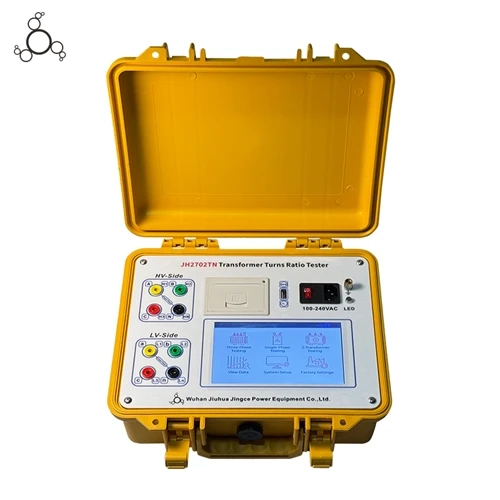
Transformer Turns Ratio Tester Working Principle: Specifically designed for measuring voltage ratio (turns ratio) and connection group:
The instrument's internal signal source applies a safe, low-voltage sinusoidal excitation signal to the high-voltage winding.
Simultaneously, it acquires the voltage amplitude and phase of the high- and low-voltage windings, and calculates the actual turns ratio using a microprocessor:
K = V<sub>H</sub>V / V<sub>L</sub>V K = V<sub>H</sub>V / V<sub>L</sub>V.
By comparing the phase difference between the voltages on both sides, the connection group (e.g., Yyn0, Dyn11, etc.) is automatically determined.
Modern equipment uses true three-phase testing technology, supporting single-phase power input and digitally synthesized three-phase output, suitable for field operations.
Transformer DC Resistance Tester Working Principle: Used to detect winding continuity, welding quality, and inter-turn short circuits:
Based on Ohm's Law (R=U/I), it uses a four-wire (Kelvin) measurement method to eliminate the influence of test lead resistance.
A constant current source supplies a stable DC current (e.g., 1A, 5A, 10A) to the winding under test, while a high-precision ADC measures the voltage drop across the winding.
The microcontroller automatically determines the steady state and calculates the resistance value. Some devices have a magnetizing function to accelerate core saturation and shorten the test time.